
When a Fort Collins homeowner lists a primary residence or rental property, the market value is largely driven by comparable sales — what similar homes in the same neighborhood sold for in the past three to six months. That approach works well for owner-occupied homes because buyers are paying for lifestyle, location, and emotional connection to the property.
For rental properties, especially duplexes, triplexes, and small apartment buildings, a pure comp-based approach often produces a price that investor buyers will not support at the underwriting table. Investment buyers are primarily paying for income — what the property earns after expenses — and they evaluate that income using metrics like net operating income, capitalization rate, and cash-on-cash return.
Fort Collins landlords who list a rental at a price justified only by retail comps frequently see investor buyers submit low offers or request deep concessions during due diligence because the income story does not support the price. Understanding how investor math works before setting your list price gives you a defensible position in negotiations and helps you attract the right buyer pool.
Net Operating Income: The Foundation of Rental Property Pricing in Fort Collins
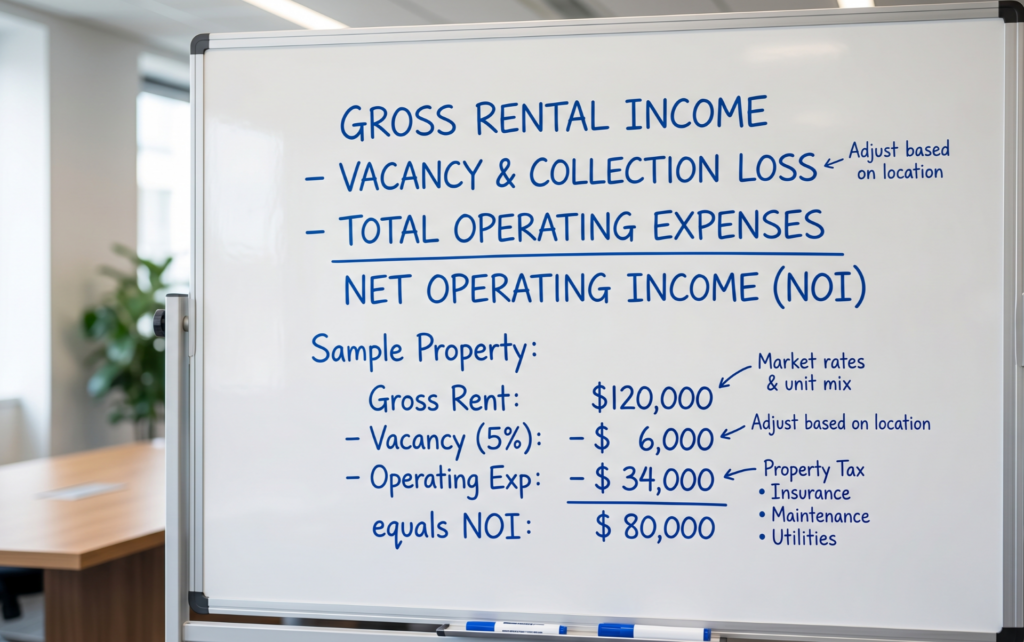
Net operating income, commonly called NOI, is the starting point for any investment property valuation in Fort Collins. NOI is calculated by subtracting all operating expenses from the property’s gross rental income, after accounting for a realistic vacancy allowance. It does not include mortgage payments or income taxes — those are specific to the owner and not the property.
Operating expenses for a Fort Collins rental typically include property taxes, insurance, property management fees if applicable, maintenance and repairs, landscaping or snow removal, HOA dues if the property belongs to an association, and a capital expenditure reserve for larger future costs like roof or HVAC replacement.
Fort Collins landlords who have operated a property conservatively often underestimate their actual expense ratio. A well-underwritten Fort Collins rental typically carries operating expenses equal to 35 to 50 percent of gross rents, depending on property age, size, and whether professional management is involved. Using a number lower than your actual experience will be exposed during buyer due diligence and can cause a renegotiation late in the contract period.
| NOI Formula: NOI = Gross Annual Rent – Vacancy Allowance (typically 5–8% in Fort Collins) – Total Annual Operating Expenses. Do NOT subtract mortgage payments from NOI. NOI is a property-level metric, not an owner-level metric. |
Cap Rate: How Fort Collins Investors Turn NOI Into a List Price

Once you have an accurate NOI figure, Fort Collins investors use the capitalization rate, or cap rate, to determine what they are willing to pay for that income stream. The cap rate reflects the expected rate of return on the property if it were purchased with all cash — no financing — and held for one year.
The basic formula is: Value = NOI divided by Cap Rate. If your Fort Collins rental property generates $30,000 in annual NOI and the market cap rate for similar properties in your neighborhood is 5.5 percent, the indicated value is approximately $545,000. A buyer using a 6.5 percent cap rate on the same NOI would arrive at a value closer to $461,000 — a difference of more than $80,000 driven entirely by a single percentage point shift in the cap rate.
Cap rates in Fort Collins vary by neighborhood, property type, and asset condition. Stable, well-maintained multifamily properties near Colorado State University or along the Mason Street Corridor typically trade at lower cap rates than older properties in more peripheral Fort Collins neighborhoods, because buyers accept a lower return in exchange for lower perceived risk. Knowing where your property sits on that spectrum helps you calibrate your list price to a defensible range.
| Fort Collins Cap Rate Reference Ranges (General Market Context) – Single-family rentals, owner-occupant demand areas: 4.5%–6% – Small multifamily (2–4 units), stable Fort Collins neighborhoods: 5%–7% – Older properties or those needing capital investment: 6.5%–8%+ These ranges shift with interest rate environments and local vacancy trends — always verify current conditions with local market data. |
Cash-on-Cash Return: What Leveraged Buyers Are Really Evaluating
Investors who plan to finance their purchase of your Fort Collins rental are not just looking at cap rate — they are evaluating cash-on-cash return, which measures annual pre-tax cash flow as a percentage of the actual cash invested (the down payment plus closing costs). This metric is directly affected by current mortgage rates and reflects what the investor will earn on their liquid capital.
When interest rates are high relative to cap rates, cash-on-cash returns compress for leveraged buyers, which can reduce their willingness to pay at the top of a comp-justified price range. Fort Collins investors who are financing at 7 percent or above on a property with a 5.5 percent cap rate are effectively buying negative leverage — meaning the cost of debt exceeds the income yield. Those buyers typically negotiate more aggressively or seek a lower price to compensate.
Understanding that dynamic helps you decide whether to target all-cash buyers, who are less sensitive to interest rates, or to price more competitively for the leveraged buyer pool. Cash For Homes Now frequently purchases Fort Collins rentals with all-cash offers, which eliminates the financing-related concession pressure that occurs when leveraged buyers feel the squeeze between cap rates and mortgage costs.
The Role of Rent Roll and Operating Documentation in Supporting Your Price
A price supported by strong NOI and a reasonable cap rate is only as defensible as the documentation behind it. Fort Collins investor buyers will request a rent roll, lease agreements, a payment history ledger, utility responsibility disclosures, operating expense records, and capital expenditure history before they finalize their underwriting. Incomplete or inconsistent documentation is one of the most common causes of price renegotiation in Fort Collins investment property sales.
Prepare a clean rent roll that shows each unit or tenant, current monthly rent, lease start and end dates, security deposit on hand, and any additional income such as pet fees or parking. Include a trailing 12-month expense summary organized by category rather than a lump-sum estimate, because investors will compare your reported expenses against their own operating assumptions and flag discrepancies.
If your Fort Collins rental has deferred maintenance, document your knowledge of those items and consider whether to address them before listing or to price them into the as-is asking price. Buyers who discover deferred maintenance during inspection and feel it was withheld will often negotiate far more aggressively than the actual repair cost justifies, because trust has been compromised in the transaction.
Pricing Strategy: When to Use Comps, When to Use Income Value, and When to Use Both
Single-family rentals in strong Fort Collins owner-occupant neighborhoods — think Old Town, Midtown, or the areas surrounding Rolland Moore Park — often justify a blended pricing approach. Retail buyers who would convert the home back to owner occupancy will pay comp-supported prices, while pure investors will underwrite on income. Pricing in the range where both buyer profiles can rationalize the number broadens your audience and creates competitive offer dynamics.
For true income-producing assets like duplexes, triplexes, or small apartment buildings, income-based valuation should anchor your strategy with comps used as a secondary check. Presenting both valuations to potential buyers — along with supporting documentation — positions you as an informed, professional seller and reduces the negotiation friction that comes when buyers feel they are doing the seller’s homework.
Seasonal timing also matters in Fort Collins. The investor buyer pool is relatively active year-round, bolstered in part by CSU-driven rental demand that makes Fort Collins an attractive long-term hold market. However, the retail buyer pool that drives comp-based value is strongest in spring and early summer. If your property can appeal to both audiences, timing a listing between March and June can support a price that captures both income-based and comp-based value in the same offer.
Get an Accurate Valuation from Cash For Homes Now Before You List
Pricing a Fort Collins rental property without understanding the investor math behind cap rates and NOI is one of the most common and costly mistakes landlords make. You may leave money on the table by underpricing, or lose time and credibility by overpricing for an audience that will not support the number through due diligence.
Cash For Homes Now provides Fort Collins rental property owners with detailed, no-obligation property evaluations that account for current income, local cap rate benchmarks, operating expenses, and the comparable sales data that shapes buyer expectations. Our team works across Fort Collins and the broader Northern Colorado market including Loveland, Greeley, Windsor, and surrounding Larimer and Weld County communities.
Whether you are preparing for a traditional listing, evaluating a direct cash sale, or simply trying to understand what your rental portfolio is worth in today’s Fort Collins market, our consulting team can give you a clear picture before you commit to a strategy. Contact Cash For Homes Now today and get a real number — one you can take to your CPA, your financial advisor, and ultimately to the closing table with confidence.