
The Central Decision Every Denver Seller Faces
If you’ve discovered unpermitted work in your Denver home, you’re facing one of the most consequential decisions in your sale: invest time and money into retroactive permitting to maximize your price, or sell as-is and prioritize speed and simplicity over top dollar.
This is not a one-size-fits-all answer. The right choice depends on the nature and extent of the unpermitted work, your financial situation, your timeline, the current Denver market conditions, and your tolerance for uncertainty. What works for a homeowner with a minor unpermitted deck might be completely wrong for someone dealing with an unpermitted basement apartment.
This article breaks down both paths in depth — the real costs, timelines, risks, and likely outcomes — so you can make the best decision for your specific situation.
Understanding Retroactive Permitting in Colorado
Retroactive permits, also called after-the-fact permits or as-built permits, allow homeowners to legalize work that was completed without proper permits. The process acknowledges that the work already exists and evaluates it against current building codes — rather than the codes in effect when the work was originally done.
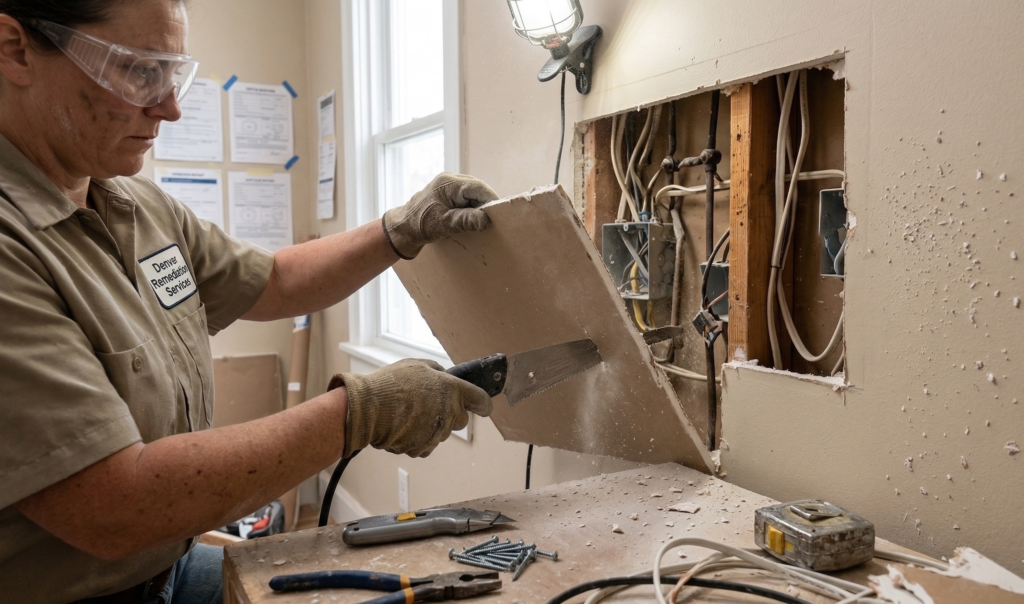
In Denver and surrounding jurisdictions, this process typically involves submitting plans or drawings of the existing work, paying permit fees, and scheduling inspections. If the work meets current code, it gets signed off. If it doesn’t, you’ll be required to make corrections — which can range from minor adjustments to significant demolition and reconstruction.
What Retroactive Permits Typically Cost in Denver
• Permit application fees: $150–$500 for minor work; $500–$3,000+ for major additions or structural work
• As-built drawing preparation (if needed): $500–$2,500 depending on complexity
• Contractor inspection costs: $200–$500 per site visit
• Code correction work: Highly variable — minor corrections may cost $500; rewiring or structural remediation can exceed $20,000
• Timeline costs: Carrying costs, mortgage payments, and market risk during 2–6 month permitting processes
The critical variable is what inspectors find when they evaluate the as-built work. If a previous owner’s contractor did quality work that happens to meet current code, retroactive permitting can be relatively affordable. If the work was done poorly or doesn’t meet modern standards, your costs can escalate dramatically and unpredictably.
When Retroactive Permitting Makes Financial Sense
Retroactive permitting is most likely to generate a positive return on investment when several conditions are true. First, the unpermitted work is substantial — a finished basement, a bedroom addition, a major kitchen remodel — because small improvements won’t justify the cost and delay of permitting. Second, the work quality is high and likely to pass inspection without major corrections. Third, you’re not in a rush, and the Denver market in your neighborhood supports premium pricing for permitted work.
In Denver’s higher-priced neighborhoods — Cherry Creek, Washington Park, Highlands, Park Hill — buyers paying $700,000 or more tend to be highly informed and financed through conventional or jumbo loans. These buyers and their lenders are most likely to require permitted improvements, and the value difference between a legally documented renovation and an unpermitted one can be $30,000–$80,000 or more in these price tiers.
If your unpermitted basement finish cost $45,000 to complete, retroactive permitting costs $5,000, and the permitted space adds $60,000 to your legitimate asking price, the math strongly favors permitting. The challenge is predicting that outcome before you begin the process — which is why consulting with a Denver contractor experienced in retroactive permits is essential before you commit.
The Hidden Risks of the Retroactive Permitting Path
Retroactive permitting comes with risks that sellers often underestimate. The biggest is uncertainty — you won’t know the full scope of required corrections until an inspector evaluates the work. Stories of sellers who began retroactive permitting expecting a $3,000 process and ended up spending $25,000 in corrections are unfortunately common in the Denver market.
There’s also timeline risk. Denver CPD processes permits on its own schedule, and staffing constraints or complex projects can extend timelines well beyond initial estimates. Every month of delay has a carrying cost: your mortgage payment, property taxes, insurance, and utilities continue — while the market may be shifting around you.
• Inspectors may require walls to be opened, destroying finishes you’ve already invested in
• Code corrections can cascade — fixing one issue may reveal others that weren’t initially apparent
• Permit applications create a public record, which means potential buyers researching the home will see ongoing permit activity
• If inspectors find serious violations — particularly in electrical or structural systems — the required corrections may cost more than the value gained
• Some older work simply cannot be made code-compliant without essentially rebuilding it
Before committing to retroactive permitting, experienced Denver real estate consultants recommend getting a written contractor assessment of the existing work’s likely compliance — before you open a permit application with the city.
When Selling As-Is Is the Right Choice
Selling as-is with full disclosure is not the path of last resort — for many Denver sellers, it’s the strategically optimal choice. The as-is path eliminates permitting uncertainty, preserves your timeline, and avoids the risk of cost overruns that can turn a profitable sale into a financial loss.
As-is sales work particularly well when the unpermitted work is difficult or expensive to legalize, when the market for your property skews toward investors and cash buyers who are comfortable with as-is conditions, when your timeline requires a fast close, or when the value difference between a permitted and unpermitted sale doesn’t justify the cost and risk of the permitting process.
The price adjustment required for an as-is sale depends on several factors. Minor unpermitted work — a deck, a fence, a utility room modification — may require only a 2–5% price reduction to attract buyers who are comfortable overlooking it. Significant unpermitted additions — a basement apartment, a garage conversion, major electrical work — may require a 10–20% adjustment or more, depending on the buyer pool you’re targeting.
Types of Buyers Who Actively Seek As-Is Homes in Denver
• Real estate investors who plan to renovate and resell — they factor permit costs into their acquisition price
• Landlords looking to add rental income — they understand and accept the permitting work required
• Cash buyers who aren’t constrained by lender requirements and can close quickly
• Owner-occupants who want a lower entry price and are comfortable handling permits themselves after closing
• House flippers who specialize in exactly this type of situation
The Cash Buyer Option: Speed and Certainty Without the Risk
For Denver homeowners who want neither the uncertainty of retroactive permitting nor the complications of a traditional as-is listing, a direct cash sale offers a third option that is increasingly popular in today’s market.
Cash buyers like Cash For Homes Now purchase homes directly from sellers, in any condition, without requiring permits, inspections, repairs, or staging. The process is designed to be simple: you contact us, we evaluate your property within 24 hours, and if the numbers work, we make you a cash offer. If you accept, we can close in as few as 7–14 days — or on whatever timeline works for your situation.
The trade-off is that a cash offer will typically come in below what you might achieve through a fully permitted, traditionally marketed sale. But for many sellers, the value of certainty, speed, and zero out-of-pocket costs for permitting or repairs more than compensates for that difference. There’s no risk of a buyer financing falling through because of unpermitted work. No inspection renegotiations. No extended timelines.
If you’re weighing your options and aren’t sure which path makes the most financial sense for your specific situation, Cash For Homes Now offers free, no-obligation consultations for Denver homeowners. We can give you an honest assessment of your property’s current condition, walk through the numbers on each path, and help you make the choice that aligns with your financial goals and timeline.
Side-by-Side Comparison: Retroactive Permits vs. Selling As-Is
Retroactive Permitting
• Potential outcome: Maximum market value, full buyer pool, financing-eligible sale
• Typical timeline: 2–6 months (or longer for complex work)
• Upfront costs: $1,500–$25,000+ depending on corrections required
• Risk level: High — costs and timeline are unpredictable until inspections are complete
• Best for: High-value improvements in premium neighborhoods where the price premium justifies the investment
Selling As-Is (Traditional Listing)
• Potential outcome: Below-peak pricing; limited to cash buyers or buyers comfortable with risk
• Typical timeline: 30–90 days on market plus closing period
• Upfront costs: Minimal — primarily agent fees and marketing
• Risk level: Moderate — deal fall-throughs possible during inspection period
• Best for: Sellers who want to avoid permitting costs and can accept a market-adjusted price
Direct Cash Sale
• Potential outcome: Below-market offer, but guaranteed close with zero contingencies
• Typical timeline: 7–21 days to close
• Upfront costs: Zero — buyer pays all closing costs
• Risk level: Very low — no financing contingencies, no inspection renegotiations
• Best for: Sellers who prioritize speed, certainty, and zero out-of-pocket expenses
There is no universally correct answer — the right path depends on your numbers, your timeline, and your risk tolerance. What matters most is making an informed decision with accurate information, ideally with guidance from a Denver real estate professional who understands all three options and has no vested interest in pushing you toward any one of them.
Ready to Sell Your Denver Home — No Matter Its Condition?
Cash For Homes Now buys houses as-is throughout Denver, CO and surrounding areas. No repairs, no permits, no hassle. Call us at (720) 599-4475 or visit cashforhomesnow.com to get your free, no-obligation cash offer today.
